
Hail Damage Claim Checklist for Florida Homeowners
Hail hit your roof? Photograph the damage the same day, write down the storm date, report the claim in writing, and do not let anyone tear off the roof before it has been inspected. In Florida you generally have 1 year from the date of loss to report a claim and 18 months to file a supplemental claim (Section 627.70132, Florida Statutes). This checklist walks you through every step.
Hail damage is easy to miss and easy for an insurer to call “cosmetic.” A roof can look fine from the driveway and still have bruised shingles that will leak in a year. Here is the checklist our public adjusters use when a homeowner calls us after a hailstorm.
Right After the Storm
- Write down the date and time the hail fell, and the size of the stones if you saw them. A coin or ruler next to a hailstone in a photo is perfect.
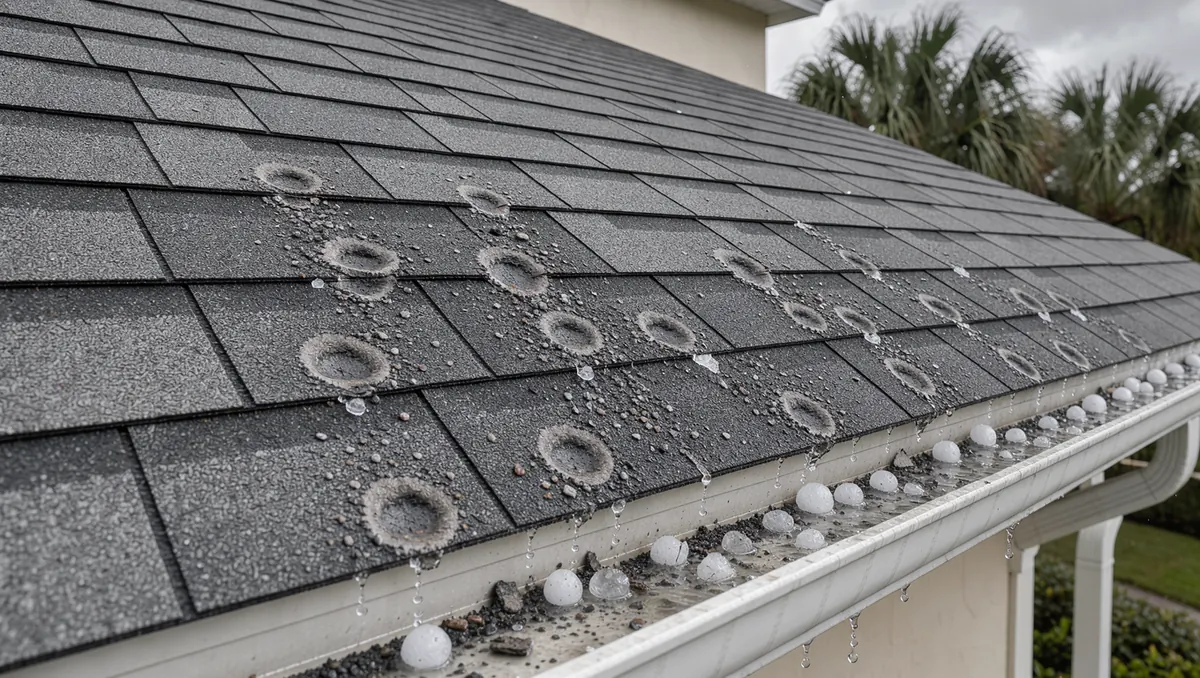
- Take photos and video of hailstones on the ground, dents in gutters, downspouts, vents, mailboxes, cars and patio furniture. Soft metals show hail hits better than shingles do.
- Check inside: ceilings, the attic and around skylights for new stains or drips.
- Cover any opening with a tarp to stop more water from getting in. Keep the receipts. Your policy expects you to protect the property from further damage.
- Do not climb on the roof. A roofer or public adjuster can inspect it safely.
Free claim review
Tell us what happened and a public adjuster will call you back. No recovery, no fee.
What Hail Damage Looks Like
- Asphalt shingles: round dark spots where granules were knocked off, soft “bruises” that feel like a bruised apple, and cracked or split shingles.
- Tile roofs: cracked, chipped or broken tiles, often at the edges and ridges.
- Metal roofs and trim: round dents in panels, flashing, vents and gutters.
- Screen enclosures, lanai roofs and skylights: torn screens, cracked panels and broken glass.
- Siding, stucco and window frames: spatter marks, dents and cracks on the side the storm came from.
Reporting the Claim
- Report the claim to your insurer and get a claim number. Follow up in writing so there is a record of the date you reported it.
- Ask for the name and license number of every adjuster who calls or inspects. Florida law requires the adjuster to give them to you (Section 627.70131, Florida Statutes).
- Be at the inspection if you can. Point out every area you photographed, including the gutters, vents and the inside of the home.
- Ask for a copy of the insurer’s detailed estimate. In Florida the insurer must send it to you within 7 days after it is generated (Section 627.70131).
Common Hail Claim Disputes
1. “Cosmetic Damage Only”
Some policies exclude cosmetic damage to metal roofs or siding. That does not mean every hail mark is cosmetic. Granule loss and bruising on shingles shorten the life of the roof and can let water in. Read the actual policy language before you accept the label.
2. “Wear and Tear” or “Old Damage”
The insurer may say the marks were already there. Weather data showing hail at your address on the date of loss, plus older photos of the roof, can answer that. Prior inspection reports and real estate listing photos help too.
3. Matching
If the shingles or tiles on your roof are no longer made, Florida law requires the insurer to make reasonable repairs in adjoining areas so the result is reasonably uniform in appearance (Section 626.9744, Florida Statutes).
4. The Roof Deductible
Some Florida policies now carry a separate roof deductible. By law it cannot be more than the lesser of 2% of your dwelling limit or 50% of the cost to replace the roof, and it does not apply when less than half the roof needs repair (Section 627.701(10), Florida Statutes). Check your declarations page.
Before You Sign Anything
Storm chasers show up fast after hail. Do not sign a contract that hands your claim to a contractor until you understand what you are giving up. Get the insurer’s estimate first, compare it to a local roofer’s estimate, and ask questions.
Stay the Course
Hail claims are won with evidence: the storm date, the photos and a detailed estimate. If your insurer called the damage cosmetic, paid too little or denied the claim, our public adjusters can reinspect and push back for you. See our hail damage claim page, our guide to a Florida roof claim denied, and our storm damage claim checklist.
Insurance Claim Consultants has helped Florida property owners with storm claims since 1990. We have offices in Tampa and Panama City Beach and answer the phone 24/7 at (800) 572-7914.
Ronald F. Delo, Licensed Public Adjuster, Florida License A065774
This checklist is general information, not legal advice or a statement about whether any loss is covered. Every policy is different and Florida law changes, so check your own policy and the current statutes mentioned above.
SERVICES
CLAIM TYPES
Industry Affiliation



Advertisements

This advertisement is made under the public adjuster licensure of Ronald F. Delo Florida License Number: A065774
